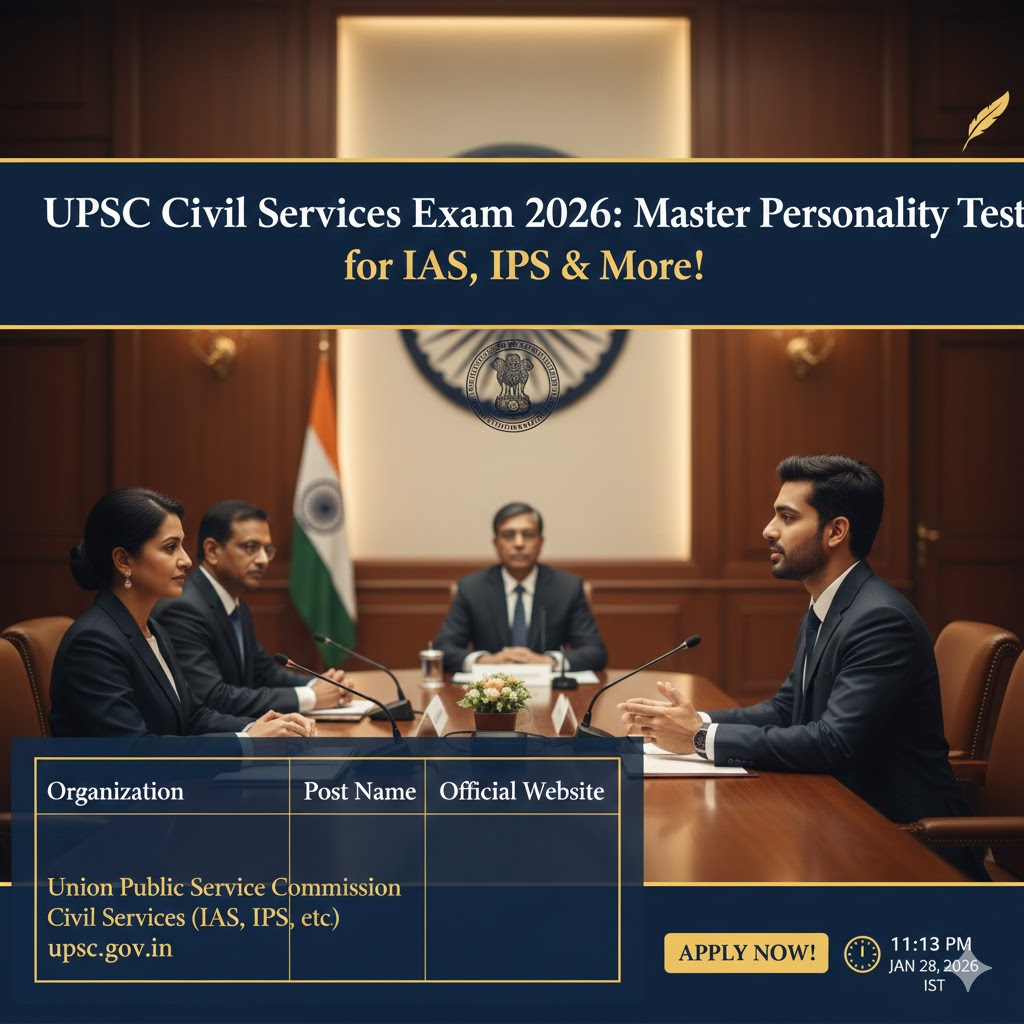
UPSC Civil Services Exam 2026: Master Your Personality Test for IAS, IPS & More!
It is a pleasure to help you refine this guide for one of the most prestigious exams in the country. I have reorganized the content to highlight the specific stages of the exam and the critical eligibility details, ensuring the tone remains professional and encouraging for 2026 aspirants.
| Organization | Post Name | Total Vacancy | Last Date | Official Website |
| Union Public Service Commission (UPSC) | Civil Services (IAS, IPS, IFS, etc.) | Approx. 1000+ | To be announced | [suspicious link removed] |
Are you aspiring to join the prestigious ranks of Indian bureaucracy through the UPSC Civil Services Exam (CSE) 2026? As an expert Indian Career Consultant, I bring you the latest job notification and crucial insights, especially for candidates with a science or engineering background. The UPSC conducts the CSE annually to recruit for various Group A and Group B posts including IAS, IPS, IFS, and many others. Prepare now to secure your dream Govt Jobs 2026!
Eligibility Criteria
To be eligible for UPSC CSE 2026, candidates must meet the following requirements:
-
Educational Qualification: Must hold a Bachelor’s degree from a recognized university. Candidates from science and engineering disciplines are particularly well-suited, bringing analytical skills to the fore.
-
Age Limit (General): Typically 21 to 32 years.
-
Relaxations: Age relaxations apply for OBC, SC/ST, and PwBD categories as per government norms.
The Selection Process
The UPSC CSE is a three-stage rigorous process designed to filter the best talent for national administration:
| Stage | Type | Focus Area |
| Stage 1: Preliminary Exam | Objective | General Studies & CSAT (Screening) |
| Stage 2: Main Examination | Written (Subjective) | Depth of knowledge across 9 papers |
| Stage 3: Personality Test | Interview | Mental aptitude, ethics, and critical thinking |
While Prelims and Mains assess your knowledge base, the Personality Test evaluates your suitability for public service. For science and engineering graduates, questions often delve into:
-
Technical Background: Ethical dilemmas in technology and technical project experiences.
-
Governance: How scientific principles apply to modern governance challenges.
-
Personal Interests: Favorite subjects and their real-world applications.
How to Apply
Once the detailed notification is released, follow these steps on the official portal:
-
Official Website: Visit upsc.gov.in.
-
Registration: Complete the One-Time Registration (OTR) if you are a new user.
-
Application Form: Fill in personal and educational details accurately.
-
Document Upload: Upload scanned copies of required documents and photographs.
-
Fee Payment: Pay the application fee online.
-
Stay Updated: Monitor the Sarkari Result portal for deadlines and exam schedules.
Study Schedule Tips:
Transitioning from a technical background to the UPSC Civil Services Examination (CSE) is a path taken by many successful IAS and IPS officers. Your analytical training is a massive asset, especially for GS Paper III (Science & Tech, Environment, Economy) and the CSAT.
Since the UPSC Prelims 2026 is scheduled for May 24, 2026, you have a clear runway to build your foundation.
Phase-Wise Strategy for Engineers
| Phase | Focus Area | Goal |
| Phase 1: Foundation (Months 1–3) | NCERTs (Class 6-12) | Unlearn “formula-based” thinking; learn to build narratives in History and Geography. |
| Phase 2: Core & Optional (Months 4–8) | Static GS & Optional | Complete your Optional Subject (e.g., Maths, Physics, or PSIR) and core GS (Polity, Economy). |
| Phase 3: Integration (Months 9–12) | Mains Answer Writing | Transition from objective problem-solving to descriptive, analytical writing. |
| Phase 4: Revision (Last 3 Months) | Prelims & Mock Tests | Focus exclusively on speed, accuracy, and current affairs. |
Weekly Study Schedule (Engineering Graduate Edition)
This 45-hour weekly plan (approx. 6–7 hours/day) leverages your “peak logic” hours for tougher humanities subjects.
Monday – Saturday: The Daily Grind
-
07:00 AM – 08:30 AM: Current Affairs (The “Input” Session)
-
Read The Hindu or Indian Express. Focus on “Why” and “How” rather than just “What.”
-
-
09:30 AM – 12:30 PM: Core Static Slot (Logic Meet Humanities)
-
Mon/Tue: Indian Polity (M. Laxmikanth).
-
Wed/Thu: Modern History (Spectrum/Bipan Chandra).
-
Fri/Sat: Economics (Mrunal Patel/Ramesh Singh). Note: Your math background makes Economy easier to grasp.
-
-
02:00 PM – 04:30 PM: Optional Subject (Technical Advantage)
-
Since engineers often choose technical optionals (Maths, Civil/Mech/Elec Engineering), use this time for high-intensity problem-solving.
-
-
06:00 PM – 07:30 PM: Bridge & Skill Slot
-
Ethics (GS IV): Practice case studies. This requires a shift from “Binary” logic to “Nuanced” ethical reasoning.
-
CSAT Practice: Spend only 2 hours a week here (since you likely already have the edge), but don’t ignore it.
-
-
09:00 PM – 10:00 PM: Daily Review & Note Making
-
Summarize your day using digital notes (Evernote/OneNote) to cater to your tech-savvy workflow.
-
Sunday: The “System Maintenance” Day
-
Morning: Weekly Current Affairs Revision (Monthly Magazines like Vision IAS/Insights).
-
Afternoon: One Mains Answer Writing session (write 2–3 answers on the topics studied during the week).
-
Evening: Planning for the next week and leisure.
3 Tips for the “Engineering to IAS” Pivot
-
Beware the “Logic Trap”: In humanities, there isn’t always one “right” answer. In your Mains answers, show multiple perspectives (Social, Economic, Political, Environmental) rather than just a linear solution.
-
Master the Diagram: Use your drafting skills! In Geography and International Relations, a well-drawn map or flow-chart can earn you an extra 1–2 marks per question.
-
Optional Choice: Don’t feel forced to take a technical optional. If you are tired of your branch, Geography or Anthropology are highly scoring and very logical/scientific in nature.
Would you like me to recommend the best textbooks specifically for the “Science & Tech” and “Environment” sections of the syllabus?
This video provides a roadmap specifically for engineering graduates, highlighting how to leverage their technical strengths while overcoming common hurdles in the humanities.