UPSC Civil Services Interview 2026: Ace Indian History – Expert Prep & Success Guide! Bonus Practice Questions !
We have meticulously reformatted this guide to ensure it serves as a high-impact resource for aspirants preparing for the final hurdle of the UPSC Civil Services Exam 2026. By focusing on the analytical side of Indian History, we aim to help candidates move beyond facts and into the realm of insightful discussion.
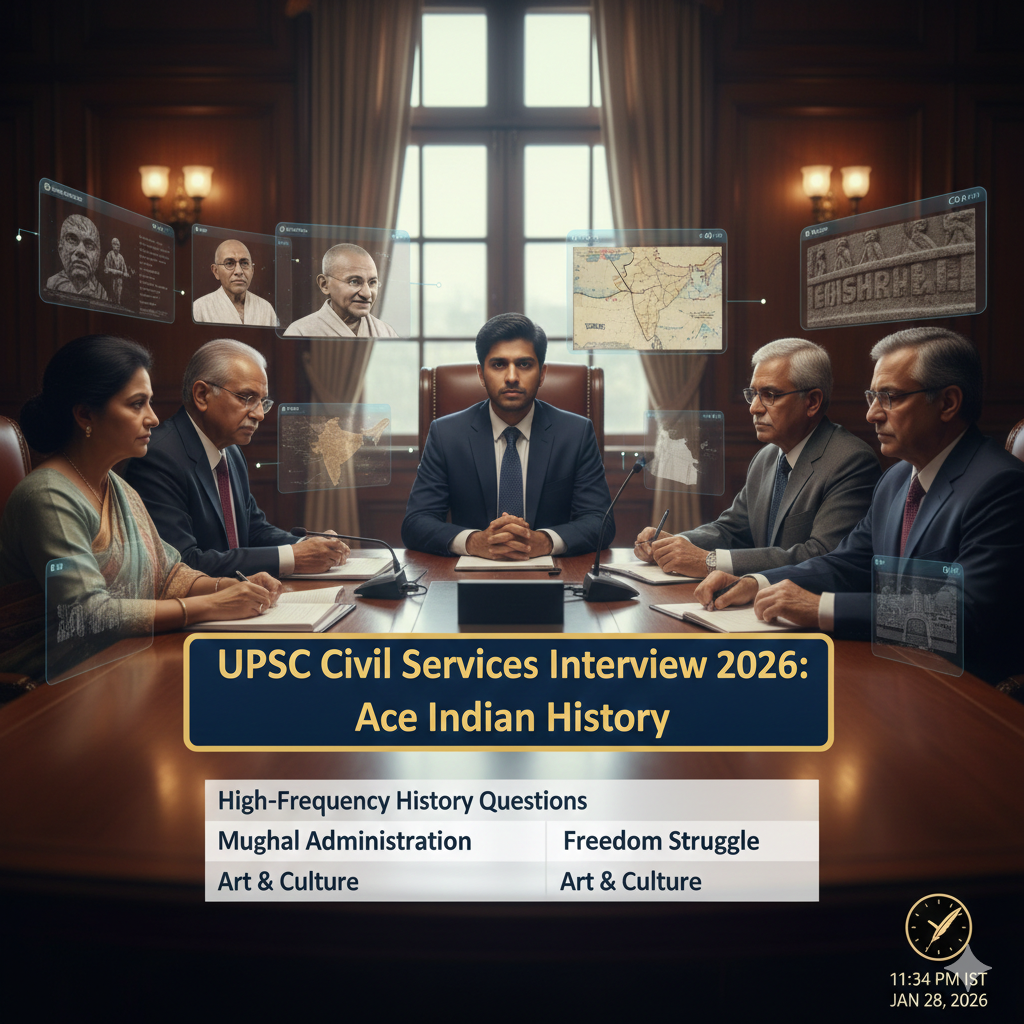
UPSC Civil Services Interview 2026: Ace Indian History – Expert Prep & Success Guide!
| Organization | Post Name | Total Vacancy | Last Date | Official Website |
| Union Public Service Commission (UPSC) | CSE Personality Test (Interview) | To be Announced | Preparation Ongoing | [suspicious link removed] |
Aspiring civil servants, the UPSC Civil Services Examination remains the pinnacle of Govt Jobs 2026 aspirations in India. While clearing the Prelims and Mains is a monumental achievement, the final frontier—the Personality Test—is where your mettle is truly tested. This stage determines your rank and service allocation. With Sarkari Result announcements always on the horizon, we recommend focusing on Indian History, as it is a frequently probed area during the board’s evaluation.
What the Panel Evaluates
By reaching the Interview stage, you have already proven your academic eligibility. We have identified the core traits the panel assesses during this interaction:
-
Mental Alertness: Quick and relevant responses.
-
Balance of Judgment: Ability to see multiple sides of a historical or modern issue.
-
Social Cohesion & Leadership: Assessing your suitability as a future administrator.
-
Intellectual Integrity: Honesty and depth of interest in India’s heritage.
Indian History: Selection & Discussion Strategy
The selection process culminates in this interview, carrying significant weight. For Indian History, we suggest preparing for discussions rather than just factual recall.
| Period/Theme | Focus Area for Discussion |
| Ancient India | Governance models, cultural synthesis, and early diplomacy. |
| Medieval India | Socio-economic impacts of various dynasties and administrative reforms. |
| Modern India | The Freedom Struggle, key personalities, and the evolution of the Constitution. |
| Current Links | Connecting historical events to contemporary governance and social policies. |
Our Expert Tips for Success
To ensure a positive Sarkari Result, we advise following these preparation and answering approaches:
-
Preparation Tips: Focus on a comprehensive understanding of all periods. Relate historical events to current affairs. Practice articulating thoughts clearly and concisely to avoid rambling.
-
Answer Approach: Do not just state facts; offer analysis. Demonstrate a balanced perspective, even on controversial topics. Be honest if an answer is unknown, but offer an informed opinion where possible.
-
Continuous Improvement: Regularly review mock interview feedback and stay updated with the Latest Job Notification insights for interview trends.
5 Steps to Master the Interview
-
Deep Dive into History: Revisit themes relevant to socio-political evolution.
-
Professional Mock Interviews: Simulate the actual UPSC environment with experts.
-
Current Affairs Linkage: Map historical contexts to present-day challenges.
-
Personal Narrative: Be ready to discuss your background and motivations.
-
Refined Communication: Practice active listening and maintaining composure under pressure.
High Frequency Questions:
I. The “Why” of History (Philosophical & Administrative)
-
Lessons from History: “It is said history repeats itself. Can you give an example where India failed to learn from its past mistakes?”
-
Administrative Continuity: “Which administrative feature of the Mauryan or Mughal Empire do you think is still relevant to a District Magistrate today?”
-
Partition: “Do you believe the partition of India was inevitable? What could have been done differently?”
-
Historical Personalities: “If you could invite three figures from Indian history to a dinner to discuss India’s future, who would they be and why?”
-
Colonial Legacy: “Has India truly decolonized its mind, or are we still running on a British-era administrative framework?”
II. Modern India & The Freedom Struggle (Most Critical)
-
Gandhi vs. Ambedkar: “Compare their approaches toward the upliftment of the depressed classes. Whose method do you find more sustainable?”
-
The 1857 Revolt: “Was it a ‘Sepoy Mutiny’ or the ‘First War of Independence’? Does the nomenclature change the historical reality?”
-
Revolutionary vs. Non-Violence: “Would India have gained independence sooner if the revolutionary movement had been the primary force?”
-
Sardar Patel: “How would the map of India look today if Sardar Patel hadn’t been the Home Minister during integration?”
-
The INA: “Assess the role of Subhash Chandra Bose in the final stages of the freedom struggle. Did the Naval Mutiny of 1946 play a bigger role than the Quit India Movement?”
III. Ancient, Medieval, and Cultural Heritage
-
Ashoka’s Dhamma: “Was Ashoka’s Dhamma a religious code or a tool for political integration?”
-
The Gupta ‘Golden Age’: “Is it fair to call the Gupta period the ‘Golden Age’ when social hierarchies like the caste system were hardening?”
-
Bhakti & Sufi Movements: “How did these movements contribute to the secular fabric of Indian society?”
-
Temple Architecture: “Why did Southern Indian temples become centers of economic activity while Northern temples faced more destruction?”
-
Akbar vs. Aurangzeb: “A common narrative pits Akbar as the ‘Liberal’ and Aurangzeb as the ‘Bigot.’ Is this historical oversimplification?”
IV. Regional History & Personal Background (DAF Related)
-
Local Heritage: “You come from [Your State/City]. Tell us about one unsung hero of the freedom struggle from your region.”
-
Historical Sites: “If a foreign tourist has only 24 hours in India, which historical site would you take them to and why?”
-
Name Changes: “What is your take on the recent trend of renaming cities based on their ancient historical identities?”
V. Themes for Rapid Revision (The Top 10 Themes)
| Theme | Common Board Perspective |
| Land Revenue | How Ryotwari/Mahalwari systems led to modern agrarian distress. |
| Social Reform | The role of women in the 19th-century Renaissance. |
| Science in History | India’s contribution to Algebra and Astronomy in the Ancient era. |
| Tribal Revolts | Why Santhal and Munda rebellions are often overlooked compared to 1857. |
| Economic Drain | Dadabhai Naoroji’s theory and its relevance to modern ‘Neo-colonialism.’ |
Strategy for Answering
-
Avoid Extreme Stands: History is often a gray area. We recommend presenting a balanced view.
-
Link to Governance: If asked about a king, talk about his revenue system or public welfare works.
-
Be Truthful: If a factual date or name escapes you, apologize and move to the analysis. The board values integrity over a walking encyclopedia.