CBSE CTET February 2026: Admit Cards Releasing Soon – Your Gateway to Government Teaching Jobs!
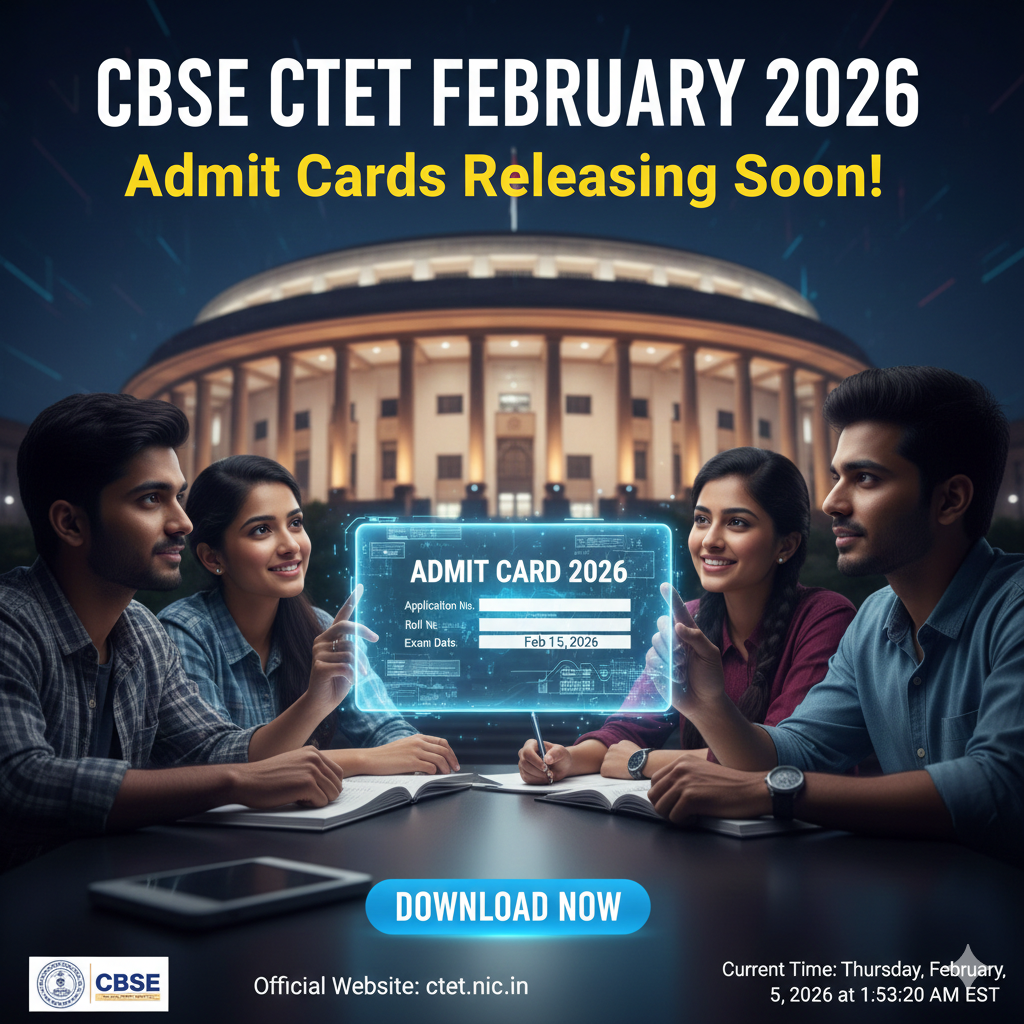
CBSE CTET February 2026: Admit Cards Releasing Soon!
The Central Board of Secondary Education (CBSE) is preparing to release the Hall Tickets for the CTET February 2026 examination. As a mandatory eligibility test for Govt Jobs 2026 in the teaching sector, this is the most critical document for aspirants targeting Sarkari Result success in schools across India.
📊 CTET February 2026: Key Information
| Organization | Central Board of Secondary Education (CBSE) |
| Exam Name | Central Teacher Eligibility Test (CTET) Feb 2026 |
| Admit Card Status | Releasing Soon (Expected 1st Week of Feb) |
| Exam Date | February 15, 2026 (Tentative) |
| Certificate Validity | Lifetime |
| Official Website | ctet.nic.in |
🧠 Understanding the Exam Pattern
The CTET consists of two objective-type papers. Candidates must score at least 60% (90 out of 150 marks) to be declared “CTET Qualified.”
Paper I (Classes I to V)
-
Child Development & Pedagogy: 30 MCQs
-
Language I & II (Compulsory): 30 MCQs each
-
Mathematics: 30 MCQs
-
Environmental Studies: 30 MCQs
-
Total: 150 Marks | 2.5 Hours
Paper II (Classes VI to VIII)
-
Child Development & Pedagogy: 30 MCQs
-
Language I & II (Compulsory): 30 MCQs each
-
Subject Specific (Maths & Science OR Social Studies): 60 MCQs
-
Total: 150 Marks | 2.5 Hours
🎓 Eligibility & Validity
-
Educational Qualification: Candidates usually hold a B.Ed, D.El.Ed, or equivalent teacher training degree.
-
Age Limit: There is no upper age limit, making this a versatile gateway for all teaching aspirants.
-
Career Impact: Qualifying CTET is mandatory for recruitment in KVS, NVS, Central Tibetan Schools, and schools under the administrative control of UTs.
📥 How to Download the Admit Card
-
Official Portal: Go to ctet.nic.in.
-
Link: Click on “Download Admit Card for CTET Feb 2026.”
-
Credentials: Enter your Application Number and Date of Birth (DD/MM/YYYY).
-
Security Pin: Enter the captcha shown on the screen.
-
Print: Download the PDF and take two clear printouts.
⚠️ Important Note: Ensure that your photograph and signature on the admit card are clear. If there is a discrepancy, contact the CBSE CTET unit immediately for rectification.
Since Child Development & Pedagogy (CDP) carries 30 marks in both Paper I and Paper II, it is the “make-or-break” section of the CTET.
Here is your Last-Minute Revision Checklist focusing on high-yield topics and the psychological theories you must have on your fingertips.
🧠 1. The “Big Three” Theories
CBSE consistently asks 5–8 questions from these three psychologists. Ensure you can distinguish between their stages:
-
Jean Piaget (Cognitive Development):
-
Focus on the 4 stages: Sensorimotor, Pre-operational, Concrete Operational, and Formal Operational.
-
Key terms to know: Schema, Assimilation, Accommodation, and Equilibration.
-
-
Lev Vygotsky (Social Constructivism):
-
Key terms: ZPD (Zone of Proximal Development), Scaffolding, and MKO (More Knowledgeable Other).
-
Understand the role of Language and Culture in learning.
-
-
Lawrence Kohlberg (Moral Development):
-
Focus on the 3 levels (Pre-conventional, Conventional, Post-conventional) and their 6 stages.
-
Pay attention to the “Social Contract” and “Universal Ethical Principle” stages.
-
🏫 2. Inclusive Education & Diverse Backgrounds (5 Marks)
Inclusive education is a core theme in the CTET 2026 syllabus.
-
Address Learning Disabilities: Know the difference between Dyslexia (Reading), Dysgraphia (Writing), Dyscalculia (Math), and ADHD.
-
Gifted vs. Creative Learners: Understand that gifted children need “Enrichment Programs,” while creative children focus on Divergent Thinking.
-
Socially Disadvantaged: How to integrate children from marginalized backgrounds without bias.
📖 3. Learning and Pedagogy (10 Marks)
-
-
Motivation: Difference between Intrinsic (Internal joy) and Extrinsic (Rewards/Grades) motivation.
-
Constructivism: The idea that children are “active builders of knowledge” rather than passive receivers.
-
Bloom’s Taxonomy: Quick review of the Cognitive Domain (Remember, Understand, Apply, Analyze, Evaluate, Create).
-
Errors: Remember that Errors are a window into a child’s thinking and should be viewed positively in the exam.
-
📜 4. National Policies & Frameworks
-
NEP 2020: Focus on the 5+3+3+4 structure and the shift toward “Competency-based learning.”
-
NCF 2005: Key principle—Connecting knowledge to life outside the school and shifting away from rote learning.
-
RTE Act 2009: Focus on age-appropriate placement and the “No Detention Policy” nuances.
💡 Quick Revision Tips for the Exam Hall
-
Positive Language: If an option suggests “Punishing,” “Labeling,” or “Segregating” a student, it is wrong.
-
Child-Centric: Always pick the option where the child is active, exploring, or participating.
-
Read “NOT” carefully: Many CTET questions ask “Which of the following is NOT…”—don’t lose marks to speed!