UPSC Civil Services Exam 2026: Mastering Global Economic Slowdown for Top Sarkari Naukri Success
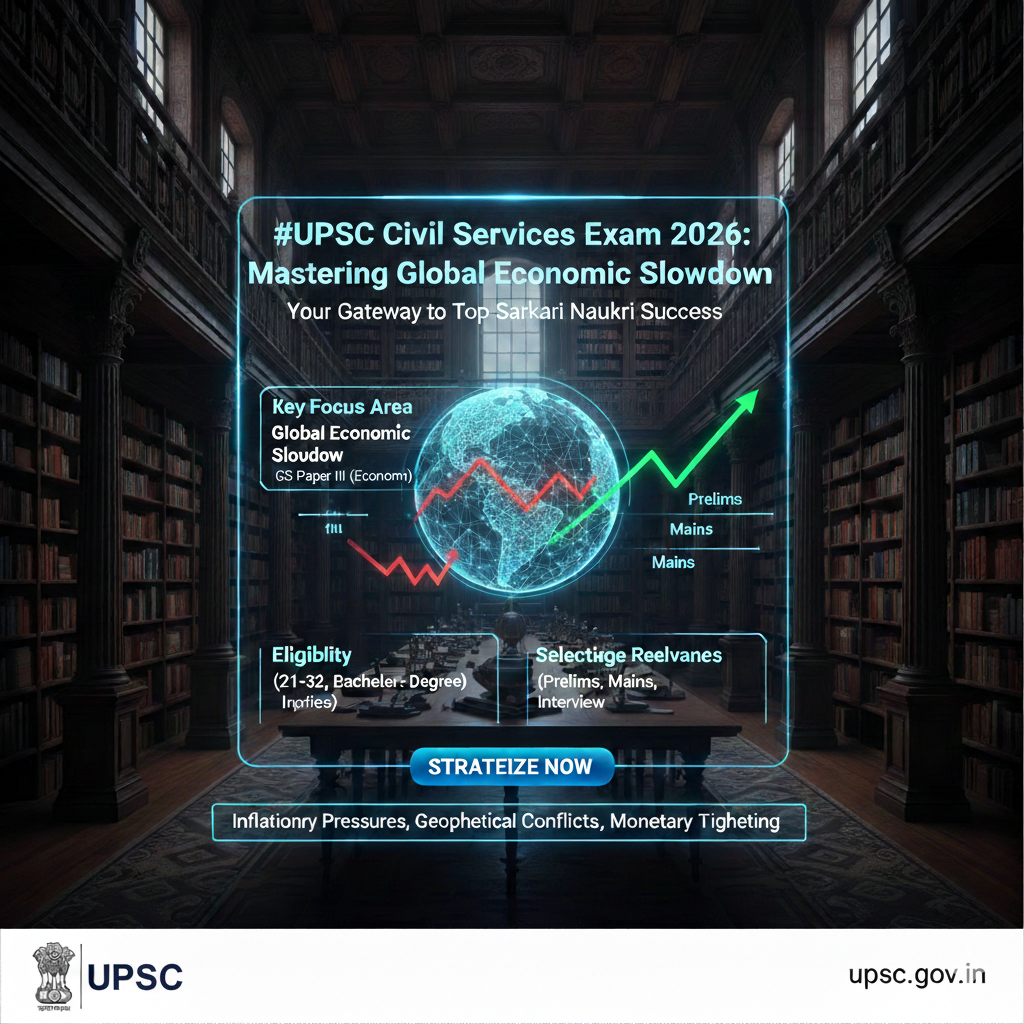
For aspirants eyeing Govt Jobs 2026, the current Global Economic Slowdown is not just a news headline—it is a core theme for GS Paper III (Economy) and the Personality Test. Understanding how global headwinds affect domestic resilience is the key to securing a top-tier Sarkari Result.
📊 UPSC CSE 2026: Economy Focus Area
| Organization | Union Public Service Commission (UPSC) |
| Exam Stage | Prelims, Mains (GS-III), & Interview |
| Key Topic | Global Economic Slowdown & India’s Resilience |
| Relevant Reports | Economic Survey 2025-26, Union Budget, IMF WEO |
| Official Website | [suspicious link removed] |
📉 Analyzing the Global Economic Slowdown
The 2026 global economic landscape is defined by “Polycrisis.” UPSC aspirants must analyze the following pillars:
-
Monetary Tightening: How interest rate hikes by the US Federal Reserve and the RBI to combat inflation are impacting liquidity and capital flows (FPI/FDI).
-
Supply Chain Resilience: The shift from “Just-in-Time” to “Just-in-Case” logistics due to geopolitical tensions.
-
Commodity Price Volatility: The impact of fluctuating energy and fertilizer prices on India’s Current Account Deficit (CAD) and Fiscal Deficit.
-
De-globalization: The rise of protectionism and its impact on India’s export-oriented sectors.
🎓 Eligibility & Selection Process
Before mastering complex economic theories, ensure you meet the baseline requirements for UPSC 2026:
-
Education: A Bachelor’s Degree in any stream from a recognized university.
-
Age Limit: 21 to 32 years (as of Aug 1, 2026), with standard relaxations for SC/ST/OBC/PwBD.
-
The Three-Stage Marathon:
-
Prelims: Objective GS & CSAT (Focus on Economic concepts & Current Affairs).
-
Mains: 9 Descriptive papers (GS-III requires deep analytical writing on the Indian Economy).
-
Interview: Assessing your ability to provide balanced, policy-oriented solutions to economic challenges.
-
📝 Strategic Preparation Roadmap
To tackle the “Economic Slowdown” topic effectively, follow this integrated approach:
-
Conceptual Clarity: Master the Philip’s Curve, L-shaped vs K-shaped recovery, and Taper Tantrum concepts from standard texts.
-
Data Integration: Use real-time data from the Periodic Labour Force Survey (PLFS) and RBI’s Monthly State of the Economy reports.
-
Policy Linkage: Relate the slowdown to government initiatives like Production Linked Incentive (PLI) schemes and Gati Shakti as counter-cyclical measures.
-
Answer Writing: Practice linking global inflation to domestic food prices and the rural economy to score high in Mains.
Here is a list of “Must-Read Chapters” from the latest Economic Survey.
The Economic Survey 2025-26, themed “Pushing the Growth Frontier,” contains 16 chapters. For a UPSC aspirant, reading the entire document is often inefficient; instead, you should focus on chapters that provide high-yield analytical frameworks for GS Paper III and the Essay.
Below is the list of “Must-Read Chapters” and why they are critical for the 2026 exam.
🔥 Tier 1: High Priority (Read Word-for-Word)
| Chapter No. | Chapter Title | Why it’s Critical for UPSC 2026 |
| 01 | State of the Economy | Provides the “Big Picture” and growth forecasts (7.4% GDP). Essential for the Intro/Conclusion of any Economy answer. |
| 10 | Environment & Climate Change | Focuses on “Building a Resilient, Competitive India.” Critical for GS-III Environment questions on Green Bonds and the Net-Zero 2070 path. |
| 14 | Evolution of the AI Ecosystem | A new-age theme. Discusses AI’s impact on structural unemployment and its deployment in public administration—highly likely for Mains 2026. |
| 02 | Fiscal Developments | Covers Fiscal Consolidation (target 4.4% for FY26). Essential for understanding debt-to-GDP dynamics and tax buoyancy. |
📈 Tier 2: Sectoral Analysis (Focus on Trends & “Boxes”)
The Survey includes small “Boxes” that explain complex concepts or case studies. Focus on these within the following chapters:
-
Chapter 04: External Sector – Playing the Long Game
-
UPSC Focus: India’s historic FX reserves ($701.4B) and the shift from “Aatmanirbhar” to “Strategic Indispensability.”
-
-
Chapter 06: Agriculture & Food Management
-
UPSC Focus: The “Horticulture Revolution” (production surpassed foodgrains) and the Digital Agriculture Mission.
-
-
Chapter 12: Employment & Skill Development
-
UPSC Focus: The implementation of the Four Labour Codes and the rising Female Labour Force Participation Rate (LFPR).
-
-
Chapter 09: Investment & Infrastructure
-
UPSC Focus: The success of PLI Schemes and the goal of reducing logistics costs below 10% of GDP.
-
💡 New Keywords & Concepts for Mains 2026
The 2025-26 Survey introduced several unique terms you should use in your answers to impress the examiner:
-
“Disciplined Swadeshi”: Balancing domestic manufacturing capabilities with global trade integration rather than pure protectionism.
-
“Orange Economy”: A new focus on the creative economy, arts, and concerts as a driver of service-sector growth.
-
“Goldilocks Zone”: Describing the current state of high growth (7%+) combined with historically low inflation (1.7%).
-
“Strategic Resilience”: Moving away from external vulnerabilities to becoming a systemically indispensable global power.
📚 How to Read the Survey Strategically
-
Don’t Memorize Tables: Focus on the direction of the graph (rising, falling, or volatile) rather than specific decimals.
-
Read the “Preface” and “Highlights”: These often contain the Chief Economic Advisor’s (CEA) core philosophy for the year.
-
Link to Static: When reading Chapter 03 on Monetary Management, relate it back to your basic notes on Repo Rate and CRR.