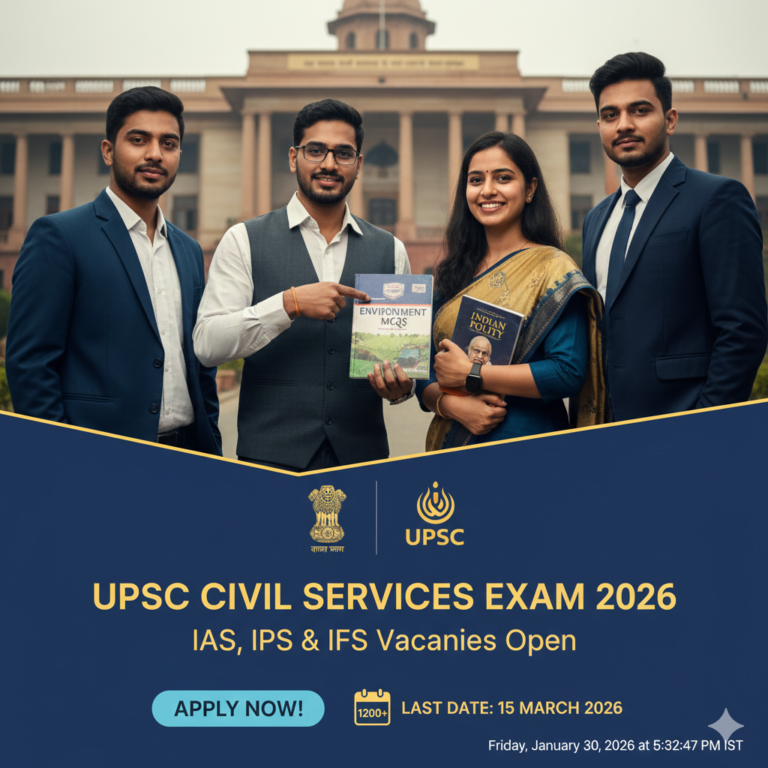
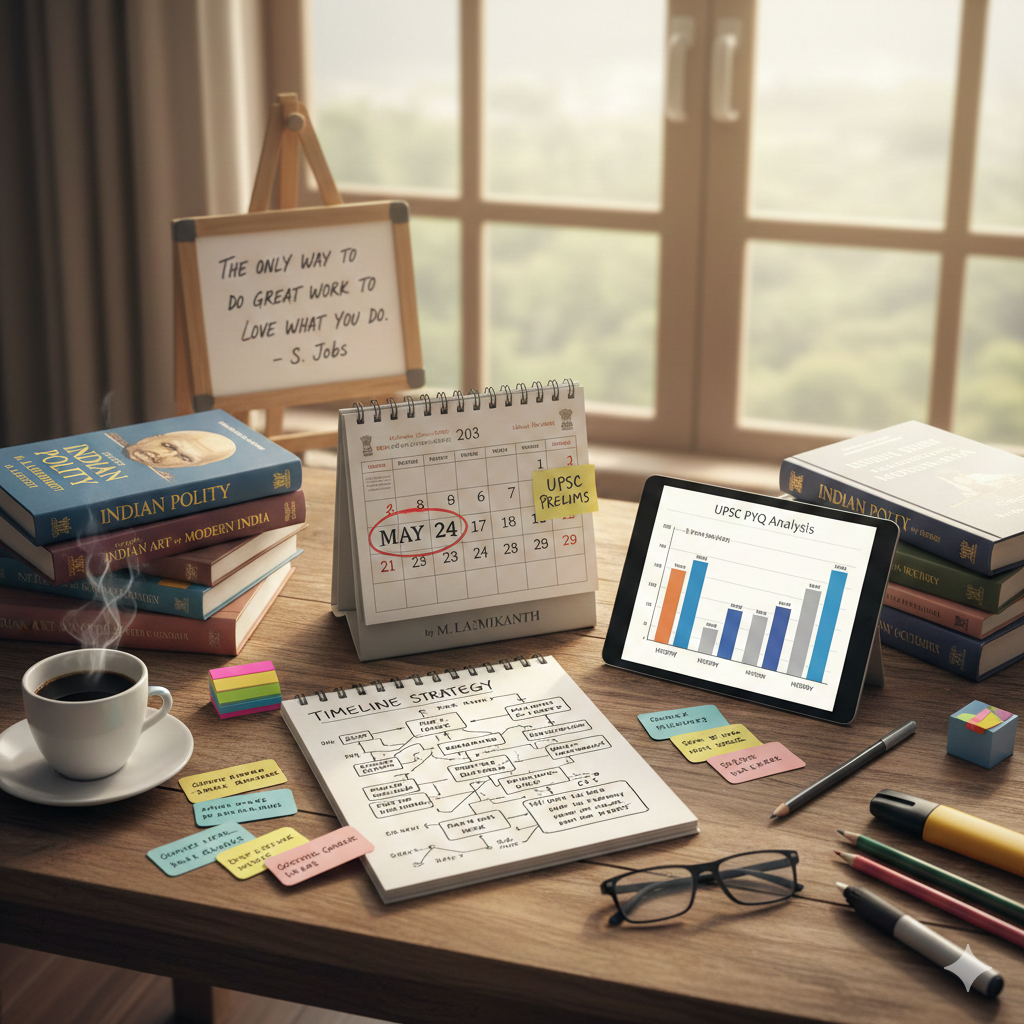
UPSC Civil Services Exam 2026: Master History for Prelims – Your Ultimate Revision Strategy! A One Year Study Roadmap Here.
The UPSC CSE 2026 is the premier gateway to India’s most prestigious administrative roles. While the official notification is pending, early preparation is the only way to stay ahead of the curve.
📋 Exam Overview: At a Glance
| Feature | Details |
| Organization | Union Public Service Commission (UPSC) |
| Exam Name | Civil Services Examination (CSE) 2026 |
| Vacancies | To be notified (Expected Feb 2026) |
| Official Website | upsc.gov.in |
⚖️ Eligibility & Selection
To qualify for a seat in the 2026 cohort, candidates must meet the following criteria:
-
Education: A Bachelor’s degree in any discipline from a recognized university.
-
Age: 21 to 32 years (as of the cutoff date). Relaxations apply for SC/ST, OBC, and PwBD categories.
-
The Three-Tier Process:
-
Prelims: Two objective papers (GS I & CSAT).
-
Mains: Nine descriptive papers (Essay, Language, 4 GS Papers, 2 Optional).
-
Interview: A personality test to evaluate suitablity for public service.
-
📜 Master Strategy: History for Prelims 2026
History is a “pillar” subject. It is high-reward but requires a vast memory bank. Here is how to conquer it:
1. The Tri-Fold Focus
-
Ancient & Medieval: Focus on Art & Architecture, administrative terms (Delhi Sultanate/Mughals), and the Bhakti/Sufi movements.
-
Modern India: This is the heavyweight section. Prioritize the 1857 Revolt, the Socio-Religious Reform movements, and the Gandhian Era (1915–1947).
2. Essential Resource List
Pro Tip: Don’t jump into heavy reference books until you’ve mastered the basics.
-
The Foundation: NCERTs (Class 6–12). Old NCERTs for Ancient/Medieval are highly recommended.
-
Modern India: A Brief History of Modern India (Spectrum) or Bipin Chandra.
-
Culture: Nitin Singhania’s Indian Art and Culture.
3. The “Timeline” Technique
UPSC loves chronological traps. Create a “Master Timeline” wall chart. If you can’t link the Non-Cooperation Movement to the Khilafat Movement and the Rowlatt Act in order, you aren’t ready yet.
4. The PYQ Pillar
Analyze the last 10 years of Previous Year Questions (PYQs). You will notice themes like “Buddhism/Jainism” and “Tribal Uprisings” recur almost every other year.
🚀 Final Countdown: Last-Minute Tactics
-
The “Flashcard” Method: Use flashcards for Governor-Generals and their specific acts (e.g., Dalhousie and the Doctrine of Lapse).
-
Map-Based Learning: Practice identifying sites for Indus Valley Civilization and Ashokan Edicts on a map.
-
Mock Drills: Take at least 10-15 full-length sectional History tests to build “elimination” skills for tricky options.
Given that the UPSC Prelims 2026 is officially scheduled for May 24, 2026, you have a perfect window to execute a balanced “Mains-cum-Prelims” strategy.
Since it is currently late February 2026, a 12-month cycle would normally start earlier; however, for an aspirant looking at the 2026 cycle, the next 12 months (March 2025 – February 2026) are the most critical.
Here is your month-by-month roadmap to success:
One Year Study Roadmap:
📅 Phase 1: The Foundation (Months 1–4)
Goal: Complete NCERTs and choose your Optional.
| Month | Subjects to Cover | Focus Area |
| March | Polity & Geography | Read NCERTs (Class 6-12). Focus on physical geography and the basic structure of the Constitution. |
| April | History (Ancient/Med/Modern) | Finish all History NCERTs. Start a basic timeline of the Indian National Movement. |
| May | Economy & Science | Understand macro-economic concepts (GDP, Inflation). Focus on Biology NCERTs for Science. |
| June | Optional Subject (Part 1) | Dedicated 4 hours/day to your Optional. Complete 40% of the Optional syllabus. |
📝 Phase 2: Intensive Integration (Months 5–8)
Goal: Move to standard books and start Answer Writing.
| Month | Subjects to Cover | Focus Area |
| July | Polity & Economy (Advanced) | Read M. Laxmikanth and Ramesh Singh. Start writing 1 GS answer daily. |
| August | Modern History & Art/Culture | Finish Spectrum (Modern) and Nitin Singhania (Culture). Link History to current news. |
| September | Environment & Ethics | Focus on Ecology and GS Paper IV (Ethics). Start solving basic case studies. |
| October | Optional Subject (Part 2) | Finish the remaining 60% of your Optional. Attempt at least 5 years of Optional PYQs. |
🎯 Phase 3: The “Prelims-First” Pivot (Months 9–12)
Goal: High-speed revision and full-length Mock Tests.
| Month | Subjects to Cover | Focus Area |
| November | Governance & IR | Focus on Mains-specific topics while keeping a foot in Prelims facts. Start CSAT (Math/Reasoning). |
| December | Full GS Revision (Cycle 1) | First complete revision of all static subjects. Join a Prelims Test Series. |
| January | Budget & Economic Survey | Focus on the newly released Govt reports. Finish Current Affairs of the last 12 months. |
| February | CSAT & Mock Drills | 2 Mock tests per week. Focus heavily on speed in CSAT. Analyze your mistakes meticulously. |
💡 Golden Rules for 2026
-
The Current Affairs Rule: Don’t just read the news; categorize it into Polity, Economy, and Environment. Use a monthly compilation to save time.
-
The CSAT Trap: Do not leave CSAT for the last month. Even if you are good at math, practice 1 hour of reasoning every weekend starting from October.
-
Active Recall: Every Sunday, do not study anything new. Only revise what you learned from Monday to Saturday.