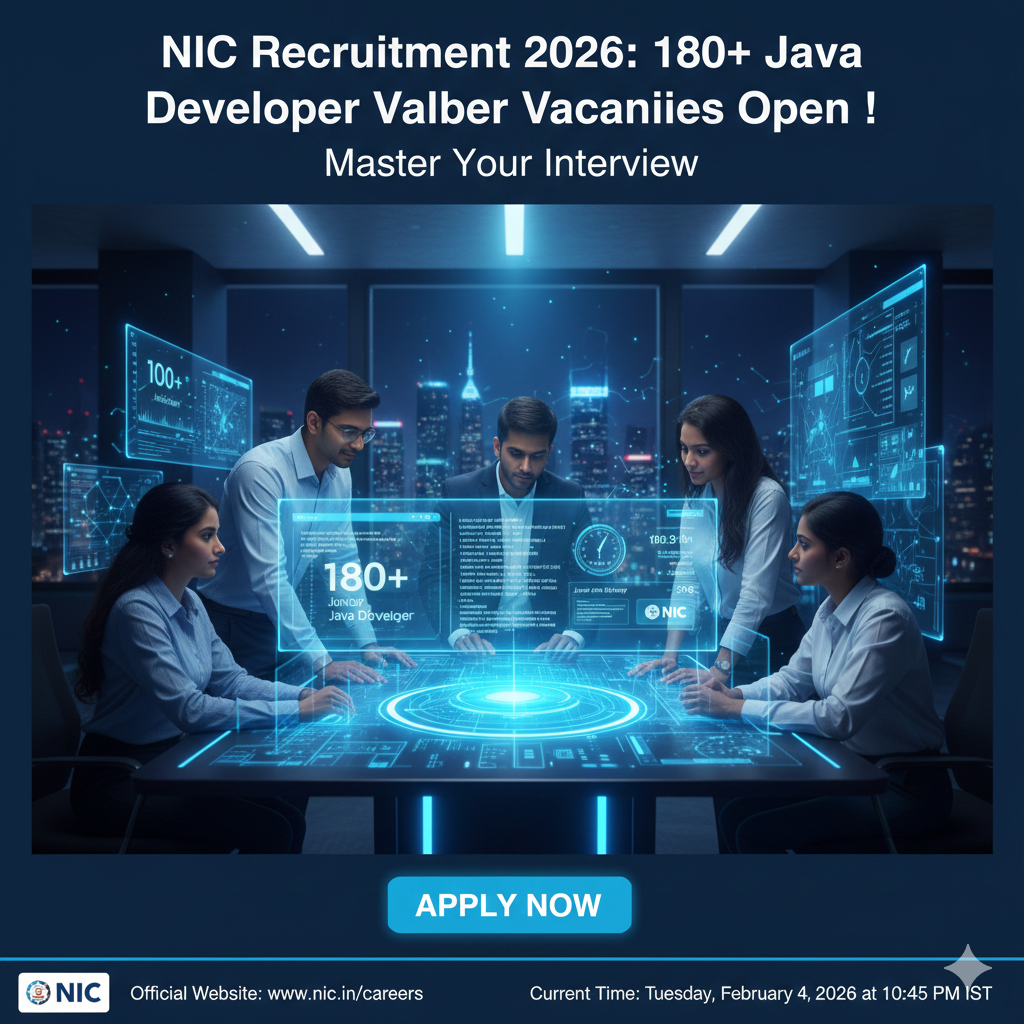
NIC Recruitment 2026: 180+ Java Developer Vacancies Open – Master Your Interview!
NIC Recruitment 2026: 180+ Java Developer Vacancies Open!
The National Informatics Centre (NIC) has announced a prime recruitment drive for 180 Junior Java Developers. This is a significant Govt Jobs 2026 opportunity for tech professionals to work on India’s most critical digital infrastructure projects.
The application portal is now open, and eligible candidates can apply until March 31, 2026.
📊 NIC Java Recruitment 2026: Quick Info Table
| Organization | National Informatics Centre (NIC) |
| Post Name | Junior Java Developer |
| Total Vacancy | 180+ |
| Application Deadline | March 31, 2026 |
| Job Category | Sarkari Naukri (IT/Technical) |
| Official Website | nic.in/careers |
🎓 Eligibility Criteria
To be eligible for this role, candidates must meet the following academic and age requirements:
-
Educational Qualification:
-
B.E./B.Tech in Computer Science or Information Technology (IT).
-
OR MCA degree from a recognized university.
-
Required Skills: Proficiency in Core Java, Spring Boot, and understanding of SQL/NoSQL databases.
-
-
Age Limit (as of the cut-off date):
-
Minimum: 18 Years | Maximum: 30 Years.
-
Relaxations: Standard age relaxations for SC/ST (5 years), OBC (3 years), and PwBD candidates as per Government of India rules.
-
📝 Selection Process: How to Qualify
The NIC selection process is rigorous and focuses heavily on technical expertise. Successful candidates will find their Sarkari Result after clearing the following stages:
-
Technical Screening: Shortlisting based on academic performance and experience.
-
Computer-Based Test (CBT): (Optional/As required) Covering Data Structures, Algorithms, and Java Fundamentals.
-
Technical Interview: A deep dive into OOPs concepts, multithreading, Exception Handling, JVM Architecture, and the Collections Framework.
-
Final Merit List: Based on the total performance in the interview and/or screening exam.
📥 How to Apply: Step-by-Step
-
Portal: Visit the official NIC careers page at nic.in/careers.
-
Registration: Register with your email and mobile number to generate a Unique Login ID.
-
Fill Form: Complete all sections, including Personal Details and Professional Qualifications.
-
Uploads: Provide scanned copies of your Photograph, Signature, and Graduation Degree/MCA marksheets.
-
Payment: Pay the application fee via the online gateway (Credit/Debit/UPI).
-
Submission: Review your details and hit “Final Submit.” Don’t forget to print your confirmation page!
To ace the NIC Junior Java Developer interview, you must balance core language theory with an understanding of how Java scales in large-scale government applications.
Here is a curated Java Interview Cheat Sheet tailored for the 2026 recruitment drive.
🏛️ 1. Java Fundamentals & JVM Architecture
NIC interviews often start with how Java works under the hood to test your foundational depth.
-
JDK vs. JRE vs. JVM:
-
JDK: Development kit (Compiler + Debugger + JRE).
-
JRE: Execution environment (Libraries + JVM).
-
JVM: The engine that runs bytecode. It’s platform-dependent, but makes Java Platform Independent (“Write Once, Run Anywhere”).
-
-
JIT Compiler: The Just-In-Time compiler increases performance by compiling bytecode into native machine code at runtime.
-
Garbage Collection (GC): Automatic memory management that deletes unreferenced objects.
-
Tip: Mention G1 Garbage Collector or ZGC for modern Java performance.
-
-
Memory Model: * Stack: Stores local variables and method calls (LIFO).
-
Heap: Stores all objects and instance variables (Shared by all threads).
-
🧩 2. Object-Oriented Programming (OOPs)
Expect “Scenario-based” questions here rather than simple definitions.
-
Abstraction vs. Encapsulation:
-
Abstraction: Hiding complexity (using Abstract classes/Interfaces).
-
Encapsulation: Hiding data (using
privatevariables andpublicgetters/setters).
-
-
Interface vs. Abstract Class:
-
Interface: Used for “capability” (e.g.,
Serializable). Supports multiple inheritance. -
Abstract Class: Used for “identity” (e.g.,
Animal). Use when classes share a common base.
-
-
Polymorphism: * Overloading: Same method name, different parameters (Compile-time).
-
Overriding: Subclass provides specific implementation of parent method (Runtime).
-
🧵 3. Multithreading & Concurrency
Essential for high-traffic government portals like those NIC builds.
-
Creating a Thread: By extending
Threadclass or implementingRunnableinterface (preferred for flexibility). -
Thread Lifecycle: New → Runnable → Running → Blocked/Waiting → Terminated.
-
Synchronized Keyword: Used to lock a method or block so only one thread can access it at a time (Prevents Race Conditions).
-
Wait() vs. Sleep():
-
wait(): Releases the lock; belongs toObjectclass. -
sleep(): Keeps the lock; belongs toThreadclass.
-
-
Deadlock: A situation where two threads are stuck waiting for each other’s locks. Avoid by using a consistent locking order.
📦 4. Collections Framework
NIC looks for developers who know which data structure to use for efficiency.
-
List vs. Set vs. Map:
-
List: Ordered, allows duplicates (
ArrayList,LinkedList). -
Set: Unordered, unique elements (
HashSet,TreeSet). -
Map: Key-Value pairs (
HashMap,TreeMap).
-
-
ArrayList vs. LinkedList: Use
ArrayListfor fast search ($O(1)$); useLinkedListfor frequent insertions/deletions ($O(1)$). -
HashMap Internal Working: Uses Hashing. If two keys have the same hash (Collision), it uses a Linked List (or Balanced Tree in Java 8+) to store them.
-
Fail-Fast vs. Fail-Safe: *
ArrayListis Fail-Fast (throwsConcurrentModificationExceptionif modified during iteration).-
CopyOnWriteArrayListis Fail-Safe.
-
🚀 5. Java 8+ and Modern Features
-
Lambda Expressions: Facilitates functional programming (concise code).
-
Stream API: Used for processing collections of objects in a functional way (Filter, Map, Reduce).
-
Optional Class: A container object used to avoid
NullPointerException. -
Default Methods: Allows adding new methods to interfaces without breaking existing implementations.
💡 Interview “Pro-Tips” for NIC
-
Be Ready for Coding: You might be asked to write a program for String Reversal, Prime Numbers, or Detecting a Loop in a Linked List.
-
Spring Boot Knowledge: Mention your familiarity with Spring Boot or REST APIs, as NIC is moving most of its legacy J2EE apps to microservices.
-
Explain “Why”: Don’t just say what a
HashMapis; explain why you would choose it over aHashtable(Thread safety vs. Performance).