
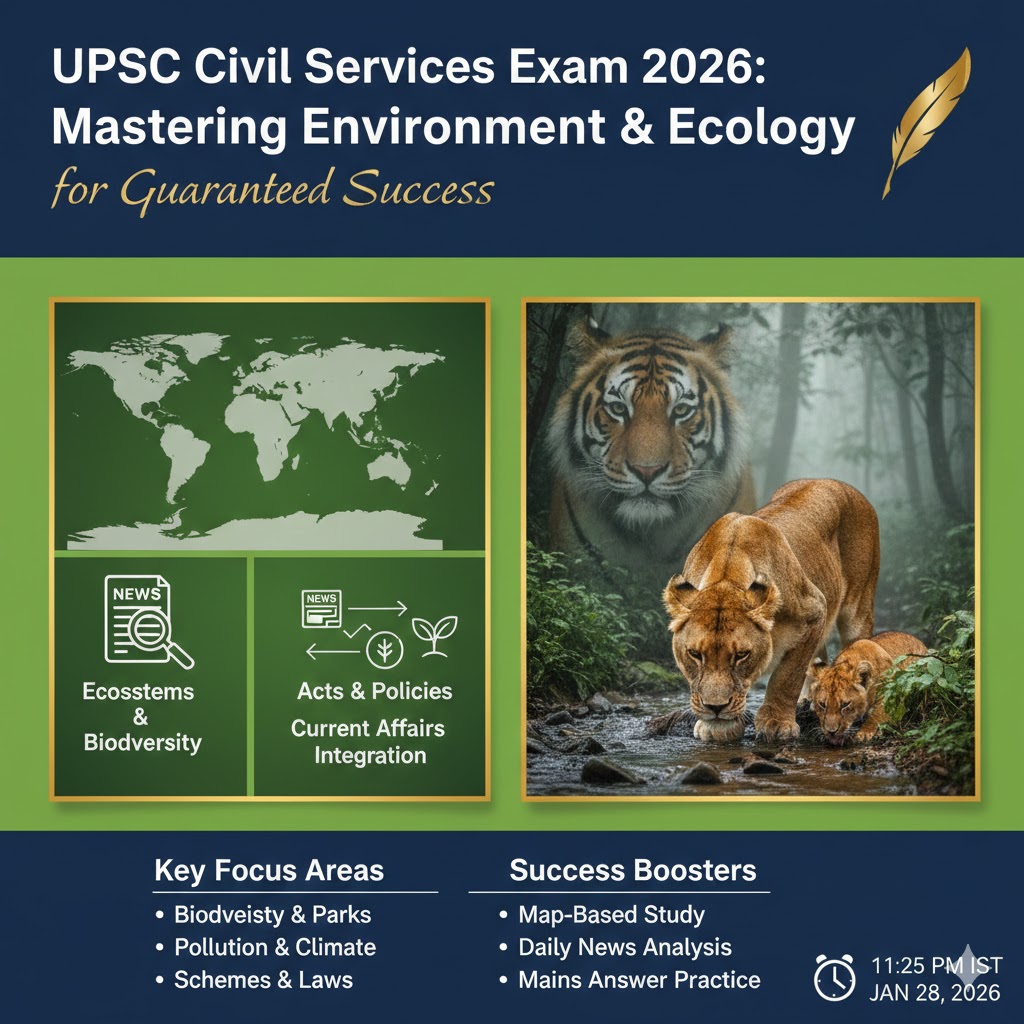
UPSC Civil Services Exam 2026: Mastering Environment & Ecology for Guaranteed Success
Environment and Ecology can often be the “make or break” factor for clearing the Prelims cutoff. We have create a guide to emphasize the weightage of the subject and the specific themes you need to master.
Quick Info Table
| Organization | Post Name | Key Area Focus | Preparation Status | Official Website |
| UPSC | Civil Services Exam (CSE) 2026 | Environment & Ecology | Ongoing & Crucial | upsc.gov.in |
Detailed Content: Your Roadmap to Environment & Ecology for UPSC CSE 2026
Aspiring civil servants, the UPSC Civil Services Exam (CSE) 2026 demands a robust understanding of Environment and Ecology. This critical subject forms a significant portion of both Prelims (GS Paper-I) and Mains (GS Paper-III). Securing a top rank and ensuring your name appears in the ultimate Sarkari Naukri Result hinges on comprehensive preparation in this dynamic area. This is a gateway to impactful Govt Jobs 2026, promising a career in public service.
Eligibility & Strategic Importance
While the basic eligibility for UPSC CSE requires a bachelor’s degree and an age between 21 and 32 years, the “true eligibility” for this section is a strategic mindset. Environment is a level playing field for all candidates, as these issues are now paramount both globally and nationally.
Selection Process: The Role of Environment
The subject’s influence spans all three stages of the selection process:
| Stage | Impact & Weightage | Key Focus Areas |
| Prelims | 20-25 Questions | Biodiversity, National Parks, and International Treaties. |
| Mains | GS Paper-III (80-100 Marks) | Conservation, Pollution, EIA, and Disaster Management. |
| Interview | Personality Test | Opinion on Climate Change, Sustainable Development, and Policy. |
A strong grasp of the comprehensive environment keyword list will significantly boost your scores and move you closer to the Latest Job Notification confirming your selection.
Master the Syllabus: “How to Apply” Knowledge
To excel, approach this subject systematically by focusing on these core pillars:
-
Foundational Ecology: Concepts of ecosystems, food chains, and energy flow.
-
Biodiversity Conservation: Deep dive into in-situ and ex-situ efforts, and protected areas in India.
-
Acts & Policies: Master the Environment Protection Act, Wildlife Protection Act, and international conventions like UNFCCC and CBD.
-
Pollution & Mitigation: Understand air, water, soil, and noise pollution alongside mitigation strategies.
-
Govt Schemes: Stay updated on Swachh Bharat Abhiyan and the National Clean Air Programme.
-
Current Affairs Integration: Connect daily news with static concepts—this is the secret to a high-scoring Sarkari Result.
Mastering the “Protected Areas” section is about more than just memorizing names; it’s about understanding the unique species, geographical features, and rivers that flow through them. This is where UPSC often creates “trick” questions.
As of 2026, India has 107 National Parks and 573 Wildlife Sanctuaries. Below is a curated table of the most frequently asked protected areas for the Prelims, focusing on the specific details that UPSC examiners love.
High-Probability Protected Areas for UPSC Prelims 2026 – A Cheat Sheet:
| Protected Area | State | Key Species | Unique Feature / Rivers |
| Kaziranga NP | Assam | One-horned Rhinoceros | UNESCO Site; Brahmaputra, Diphlu rivers flow through it. |
| Keibul Lamjao NP | Manipur | Sangai (Dancing Deer) | The world’s only floating national park (Phumdis). |
| Hemis NP | Ladakh | Snow Leopard | India’s largest National Park; High-altitude cold desert. |
| Desert NP | Rajasthan | Great Indian Bustard | One of the natural habitats of the critically endangered GIB. |
| Dachigam NP | J&K | Hangul (Kashmiri Stag) | Located in the Zabarwan Range; Dagwan river. |
| Silent Valley NP | Kerala | Lion-tailed Macaque | Part of the Nilgiri Biosphere Reserve; Kunthipuzha river. |
| Namdapha NP | Arunachal | Hoolock Gibbon | Only park with four big cat species; Noa-Dihing river. |
| Jim Corbett NP | Uttarakhand | Bengal Tiger | India’s first National Park (1936); Ramganga river. |
| Keoladeo Ghana | Rajasthan | Siberian Crane (Migratory) | Man-made wetland; Confluence of Gambhir & Banganga. |
| Bhitarkanika NP | Odisha | Saltwater Crocodile | Famous for Olive Ridley Turtle nesting at Gahirmatha. |
Strategic Study Tips for Protected Areas
-
Mapping is Mandatory: Don’t just read the table. Open an atlas and mark these parks. UPSC often asks you to arrange them from North to South or East to West.
-
Focus on the “News”: If a park is mentioned in the news (e.g., Cheetah reintroduction in Kuno NP or floods in Kaziranga), it becomes a 90% probability for the next Prelims.
-
The “River-Park” Connection: Recently, UPSC has shifted toward asking which river flows through which park.
Quick Facts for Revision
-
Largest NP: Hemis National Park (Ladakh).
-
Smallest NP: South Button Island National Park (Andaman & Nicobar).
-
First NP: Jim Corbett (formerly Hailey National Park).
-
Newest NP: Dehing Patkai and Raimona (Assam) were among the most recent additions.